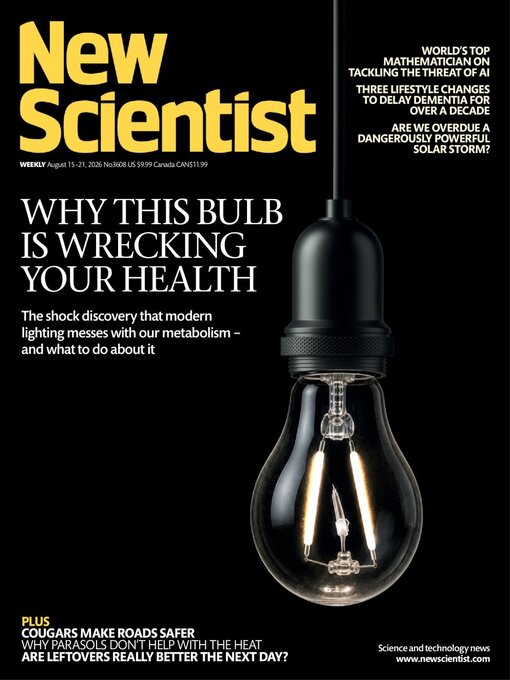
New Scientist covers the latest developments in science and technology that will impact your world. New Scientist employs and commissions the best writers in their fields from all over the world. Our editorial team provide cutting-edge news, award-winning features and reports, written in concise and clear language that puts discoveries and advances in the context of everyday life today and in the future.
Writing the future • We shouldn’t let tech companies decide where our story is heading
New Scientist
Can we stop Arctic ice escaping? • Researchers are investigating whether artificially thickening “ice arches” between Canada and Greenland could prevent swathes of ice from flowing south to melt, finds Alec Luhn
Best images of the sun yet reveal waves never seen before
OpenAI cracks 10 enduring maths problems
Maths laureate quits field for AI • Recent Fields medal-winner Jacob Tsimerman is changing course to work with OpenAI on making artificial intelligence safer, reports Karmela Padavic-Callaghan
Three factors can delay dementia by 13 years
Dead bacteria supplement may aid weight loss
Some leftovers really do taste better the next day
Europe faces energy crisis • High temperatures and droughts have forced several countries to shut down nuclear reactors, raising energy prices and the threat of blackouts, reports Madeleine Cuff
Faecal capsules may ease peanut allergy
Dog DNA edits stop allergies • A company has created two beagles that don’t have the main protein that provokes allergies, and hopes to get approval to start selling them, reports Michael Le Page
Huge dam may have powered early pyramid’s construction
AI gives earlier warning of cyclones • Machine-learning models are proving to be powerful tools for weather forecasting
Rogue SpaceX rocket smashes into the moon
Cougars have a big benefit for road safety
Wildfire smoke cut solar power output
Are pet flea treatments safe? • It has long been assumed that parasite treatments for pets pose no threat to wildlife or people, but there is growing evidence that we have got it wrong, finds Michael Le Page
Hairy plant with a taste for gnats proves Darwin’s hunch correct
Sitting under beach umbrellas may not really cool you down
Quantum reset • To predict when we will have a truly useful quantum computer, we need to know precisely what one is – but that is a tricky endeavour, discovers Karmela Padavic-Callaghan
Problematic peptides • A US drug advisory committee has recommended approval for several experimental peptides. This gives the wrong impression of their effectiveness, says Grace Wade
Buried treasure
Three great reads on food, health and exercise
What should I really eat? • Besieged by confusing and contradictory advice on which diets are best for us, Chris Simms enjoys a clear-eyed evolutionary view from Daniel Lieberman
New Scientist recommends
The Thing lives! • It’s 1987, and detective Georgia Cooke finds mangled bodies at an outback radio research station. TV columnist Bethan Ackerley recommends a terrifying slice of cosmic horror
Your letters
Red-light starvation • Since the 2000s, the spectrum of light we are exposed to has drastically shrunk. Now, we’re learning how this can wreak havoc with our metabolism, finds Graham Lawton
Storm warning • Signs hidden in the world’s oldest tree rings suggest that our sun is capable of solar storms far bigger than we’ve ever recorded – and we could be due one soon, reports Jacklin Kwan
When we saw the sky erupt • In 774-775 CE, tree rings recorded an abrupt jump in carbon-14 – the signature of an extreme particle storm now known as the first discovered Miyake event
The six...