New Scientist covers the latest developments in science and technology that will impact your world. New Scientist employs and commissions the best writers in their fields from all over the world. Our editorial team provide cutting-edge news, award-winning features and reports, written in concise and clear language that puts discoveries and advances in the context of everyday life today and in the future.
A bit hormonal • For too long, scientists have ignored the impact of fluctuating female hormones
New Scientist
A new replication crisis? • A review of thousands of scientific papers about quantum computers suggests results from one computer may not be reproducible on another machine, reports Karmela Padavic-Callaghan
Rapid CO₂ rise could see the end of a critical ocean current
Blood’s body clock means anaemia cases may be missed
Quantum solution to 250-year-old puzzle
Earth microbe can grow in Mars-like conditions
Wildfires shaped human evolution • A reconstruction of East Africa’s environment 1.75 million years ago suggests wildfires spiked in wetter times, and our ancestors may have taken advantage, finds James Urquhart
Iron Age Britain was a woman’s world • Clans in north-east England were organised around maternal lineage in the centuries leading up to the Roman conquest of Britain, discovers Michael Le Page
Hibernation upends our understanding of how brains store memories
Sound rainbows exist, and we now have the best ever
Heart surgery sends man’s skin cancer into remission
Denisovans may have towered over other humans
How quantum is a proton? • Our understanding of the internal structure of protons is largely based on classical physics, but we are now uncovering quantum behaviour, finds Karmela Padavic-Callaghan
Mutant phages treat E. coli infection • CRISPR-armed bacteria-killing viruses may have helped clear an antibiotic-resistant infection
A bomb is detonated every hour in one coral reef
Young galaxy is home to black hole triplets
Oldest signs of live births in mammal ancestor
AI is changing cybersecurity • Attackers with no technical skills can now use AI models to find and exploit loopholes quickly, on a massive scale – and experts are worried, reports Matthew Sparkes
How curious • Asking people questions about their lives is the secret sauce to human connection – so why do people ask so few, asks David Robson
What matters for matter • The standard model of physics is one of the most successful scientific theories we have, but could we eliminate any particles from it, asks Chanda Prescod-Weinstein
An icy feast
Four similar books to explore
A trip too far • The Ego Trip tells the wild story of the doctor who claimed amazing powers for the psychedelic secreted by desert toads. Olivia Goldhill is gripped
New Scientist recommends
In the web • A rich widow, a disillusioned cop and a dim hypersled driver are caught in the machinations of the oppressive party ruling the Decurion Empire. Sci-fi columnist Emily H. Wilson enjoys their struggles in The Infinite State
Your letters
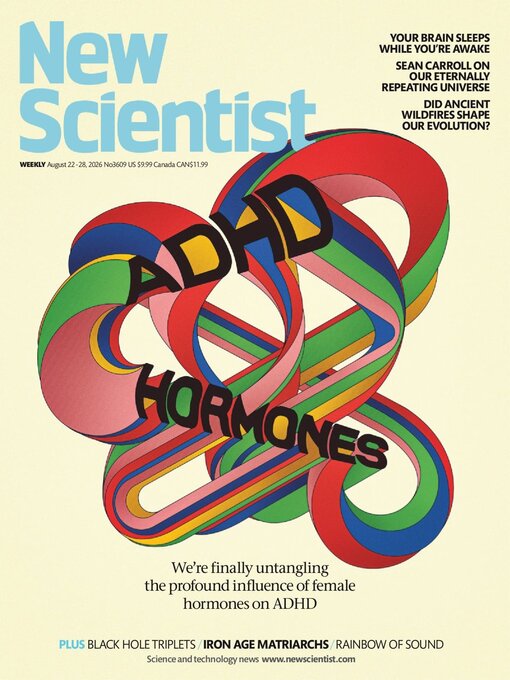
Tangled ties • Women with ADHD are unusually sensitive to hormone shifts. Unravelling why is helping them better manage their symptoms, finds Caroline Williams
The power of wakeful rest • We may be able to get some of the memory and learning benefits of sleep while awake, discovers Amanda Ruggeri
Half asleep
“Wait long enough and the entire history of the universe repeats exactly” • In an attempt to reconcile classical and quantum physics, quantum cosmologist Sean Carroll uses quantum theory as his guide. He tells Jacklin Kwan how this means we may be stuck in an eternally repeating...